Celine and I talk a lot about the artistic vision of the author and how that is impacted by a world pervaded by the Internet, AI, and mass capitalism demanding quick fixes (talking of which, have you pre-ordered your copy from your local bookshop, Waterstones, Foyles, or Amazon yet?)
Writing is a curious thing: the writer has to use the reader’s imagination to envision the worlds and people that they create. Yet, the modern world demands pictures and merch. So how do we try to maintain our artistic vision, leaving space for the reader’s imagination, while accepting the demands of an image hungry world? I’m going to explore how we’ve approached this for the Dead Shadow by examining artists interpretation of the Lord of the Rings. Well, that’s the plan, anyway…
Why the Lord of the Rings?
By the time I was 11, somewhere in the mids-80s, I think I had already read the various Lord of the Rings books about three times each and was a huge fan. My older brother was already into D&D – which in the UK in those days meant Fighting Fantasy books, table top dungeons, and Games Workshop figures, often based around the Lord of the Rings. I remember him once playing the battle of the five armies with his friends – something I was too young (and almost certainly too annoying) to be involved with
You can see some examples of my best attempts to paint some of the very early lead figures below, daubed with the few Humbrol enamel paints that I had access to in my childhood bedroom. Warg riders on the left, Strider and some dwarves (probably including Gimili) on the right


Other views of Middle Earth
Alongside this, Radio 4 ran an audio adaptation, Led Zepplin made references in their music (for example: Led Zepplin IV, battle of Evermore), and many books and guides to Middle Earth were published featuring history and pictures. Here are some examples from books that I bought at the time and still own today


References to these books
If you are interested in this type of thing, these are taken from the following books:
- Tolkien: The Illustrated Encyclopedia (David Day, 1991)
- A Tolkien Bestiary (David Day, 1979)
- A-Z of Tolkein (David Day, 1993)
- The Guide to Middle Earth (Iain Lowson, Pete Macenzie, Keith Marshall, 2001)
Diversity of vision
What this leads me to, is that I grew up with an enormous diversity of vision. Many interpretations of what Middle Earth is and many different views of what it meant. None of which prevented my imagination from forming its own view about the places and people. There was no right or wrong of who they were or what the world looked like
In many respects, this is the essence of writing for me – although we (as writers) have a vision and an idea, you (as readers) interpret that through your own lived experiences. Your imagination builds our vision in a way that makes sense to you. In other words: no two people reading a book will have formed the same image. Even Celine and I have different views about the people in the Dead Shadow
Enter the films (stage right)
You might argue that Peter Jackon’s tremendously successful and very beautiful films are a continuation of this long tradition of interpreting Tolkien’s work, and in some respects I’d agree with you. However, I only managed to watch one of them before I had to stop. This might be surprising because, as you might have noticed, I was somewhat of a Tolkien addict as a child
So what happened? I can probably sum it up as ‘but that’s not my Gandalf’ or ‘but I loved the Dwarves, why have you made them into a bad comedy set?’ There’s also something niggling me about the fact that for an entire generation of Tolkien fans the whole deep, complex world is now little more than just another film. These days if I Google (or Bing – as if anyone does that) the Lord of the Rings or ask what a hobbit looks life, this is what I get

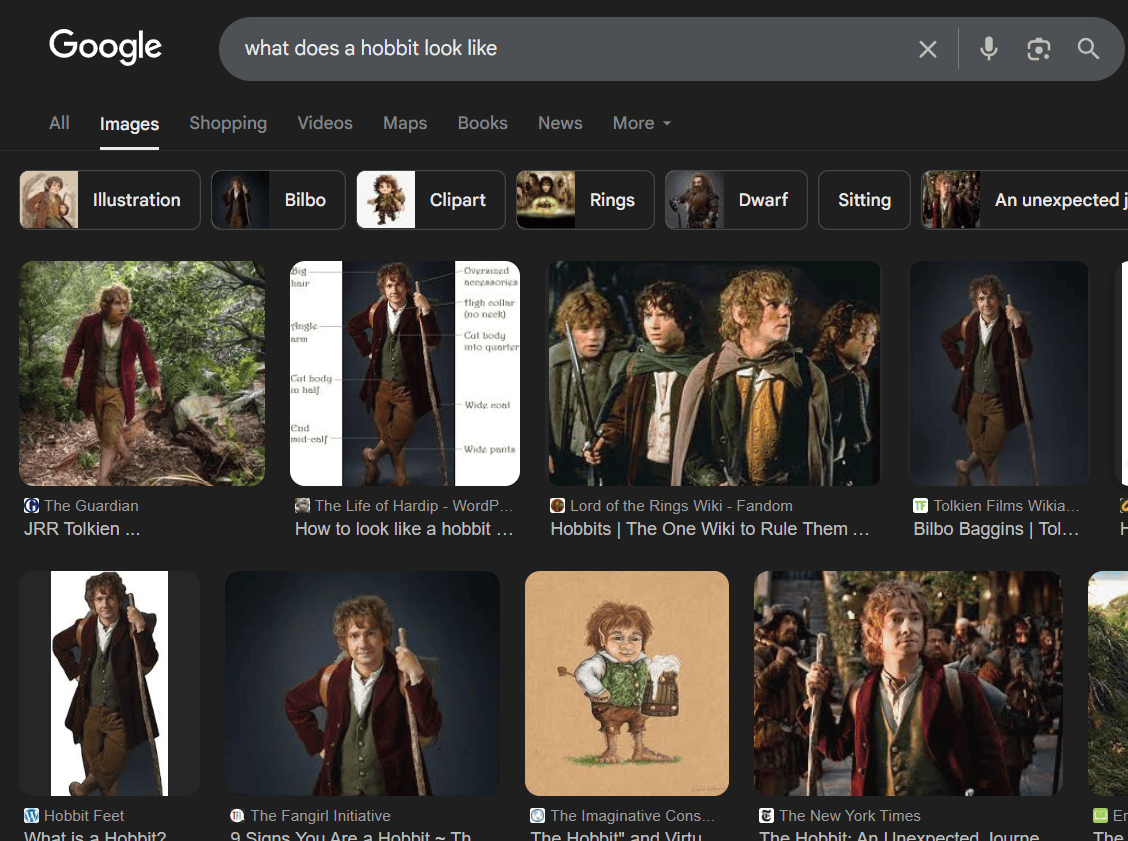
Essentially, Peter Jackon’s version. Again, absolutely nothing wrong with the magnificent work that he did, it’s just that this has now become the standard. If you draw Gandalf and it doesn’t look like the one in the films, you’ve done it wrong. Personally, I don’t like that. As I watched the first film I could feel the Middle Earth of my childhood starting to crumble, my Hobbiton and Mirkwood fading. That’s why I stopped watching them. I wanted to keep my world and my imagination
Artistic vision and the Dead Shadow
So, to bring this all back to the Dead Shadow. When Cranthorpe and Millner first asked us about ideas for a cover it took us a long time to come up with an answer. While a cover needs to jump out at readers from the bookshelf, we also didn’t want anything that tightly defined the world and prevented the reader from using their imagination. Early Lord of the Rings art eventually became our inspiration: wood cut type drawings, loosely defined with space for the imagination. Somehow the excellent team at Cranthorpe and Millner managed to come up with what we have today

In addition to this, we also wanted to let other artists interpret the world as they saw fit. We wanted the pictures and visions of other artists, but not in a way that defined either them or our readers to a single view
Enter the artists (stage left)
With this in mind, we have been speaking to artists that we know, or have met over the years, to ask them for their interpretations. To try and keep things simple, we wrote four short briefs about some key characters: the Shadow, Rhode, Pamphilos, and Helena. You can read all about them here
The key is that although we commission these folks (unless they are friends or family who insist on a coffee or mate’s rates) we leave them completely free to decide how they want these people to look. They have the brief, they can ask us questions, but outside of that what matters to us is not that we love what they draw but that it’s their authentic vision – without us saying things like: ‘that’s not what we thought’ or ‘the Shadow should be a bit more magnificent that that’
We’d like to follow in the multifaceted tradition of Tolkien, and so far have one musician (we’re always on the lookout for more) and a bunch of artists (some of whom are still busy drawing, as I write!) The whole point is to have many different views, from many different and varied people with different and varied backgrounds
Why? Partly because it shows that many interpretations are valid. And that’s OK. We can have different ideas and still all be on the same side. Also partly because it’s just a lot of fun. There’s nothing wrong with that – the world needs more fun!
You can view where we’ve got to so far on the artists page of this site. This page will keep changing and being updated as we find more folks and get more submissions, so keep checking back!
If you are an artist of any kind and would like to get involved, please get in touch and join in!